
Shaping the Future of Laser Micromachining

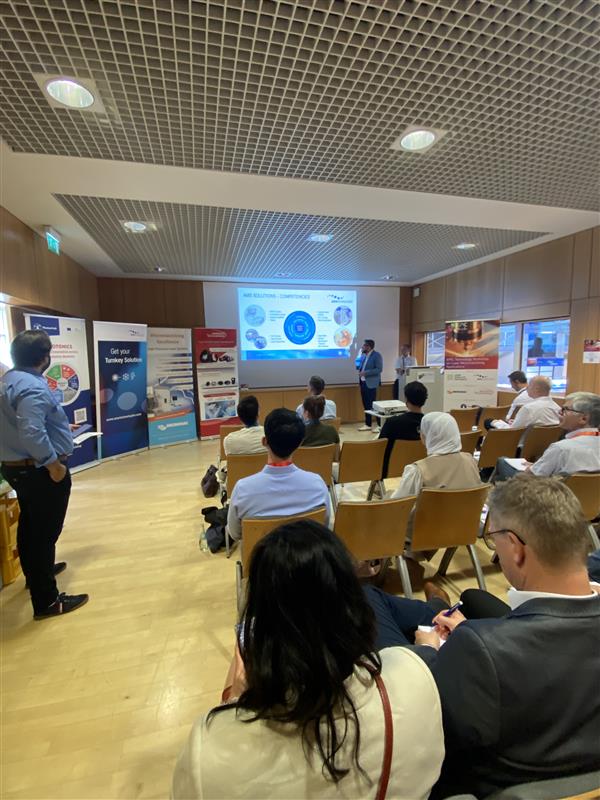
The EPIC Technology Workshop on Laser Micromachining Applications was held during the Laser World of Photonics 2025 in Munich, in collaboration with AMS Technologies.
The session focused on practical developments in laser-based microfabrication, with presentations from companies and research institutions working on beam shaping, polarization control, and integrated laser systems. The workshop provided a platform for discussing technical challenges and solutions in achieving higher precision, speed, and adaptability in industrial laser processes.
Multi-Seed MOPA Lasers: Precision Meets Power
neoLASE (Presented by Maik Frede)
neoLASE showcased its multi-seed Master Oscillator Power Amplifier (MOPA) technology, offering a versatile laser solution that merges nanosecond (ns) and ultrashort pulse (USP) regimes in one chassis. This integration allows users to switch seamlessly between high-throughput bulk material removal with ns pulses and fine, low-thermal-impact processing with femtosecond or picosecond pulses.
Their neoYb and neoVAN platforms demonstrated outputs exceeding 1 mJ per pulse and up to 200 W average power, enabling applications in:
- Microfluidics mold tooling with hydrophobic/hydrophilic patterning.
- Biomedical devices, benefiting from hydrophilic surfaces for reduced protein adsorption.
- LIPSS formation, fine polishing, and multi-pass surface finishing.
By co-aligning beamlines and minimizing the need for dual-system setups, neoLASE provides an efficient, compact solution to address complex micromachining workflows.

Spatial Light Modulation: Amplitude and Phase Reimagined
Silicon Light Machines (Presented by Lars Eng)
Silicon Light Machines introduced two game-changing spatial light modulation technologies for next-generation laser processing:
- Planar Light Valve (PLV):
- A high-power amplitude modulator supporting up to 800 W CW and 150 W ultrashort pulses.
- Enables programmable line beam scanning, ideal for high-resolution laser marking (2400 DPI) and black marking on metals.
- Demonstrated success in stainless steel marking, polishing, thin film removal, and even emerging color marking.
- Displacement Phase Modulator (DPM):
- A high-speed phase modulator operating at up to 250 kHz with 7-bit linearized DACs.
- Enables dynamic beam shaping and multi-beam processing, paving the way for applications in beam homogenization, wafer grooving, and welding.
- Future roadmap includes a 128×128 pixel version with support from UV to NIR (343–1550 nm), aiming for ≥1 kW CW and 1 mJ USP capabilities.
With their Katana™ Light Engine, SLM positions itself to unlock high-throughput, precision-driven laser microfabrication with fine control over spot geometry and energy delivery.

Passive Beam Shaping for Laser Manufacturing
Technology Innovation Institute (Presented by Mariam AlKhateri)
TII’s Directed Energy Research Center introduced a compact and passive Random-to-Radial (R2R) polarization converter designed to enhance the consistency of high-power fiber laser machining. The core motivation lies in addressing the issue of random polarization from fiber lasers due to birefringence, which affects absorption stability during laser-material interaction.
Key highlights:
- The R2R device converts randomly polarized beams into radially polarized beams, yielding uniform absorption, steeper gradients, and tighter focusing.
- Demonstrated improved performance in cutting, welding, and drilling, especially for:
- CO₂ laser cutting of metals.
- Fiber laser welding of steel.
- Picosecond drilling of CrNi steel.
TII is now advancing the technology toward high-power laser compatibility, further supported by its EmiRay™ laser portfolio, ranging from 1 μm to 2 μm CW and pulsed sources, optimized for diverse industrial and scientific needs.

From Micro-Processing to Macroscale Applications
Amplitude (Presented by Vincent Rouffiange)
Amplitude demonstrated how high-power femtosecond lasers can scale from precision micro-processing to large-scale industrial applications. By combining high repetition rate strategies (advanced beam steering, Femtotrig® for precise pulse control) with multispot energy distribution, the company achieves up to 15× faster processing while reducing costs by a factor of 3.
This approach preserves machining quality, eliminates burrs, and enhances efficiency in demanding applications such as OLED cutting, wafer processing, and battery electrode manufacturing. High-power ultrafast lasers are now positioned to unlock new industrial opportunities by improving both throughput and cost-effectiveness.

Dicing Solutions for SiC Wafers
DISCO HI-TEC Europe (Presented by Benjamin Bernard)
DISCO presented its latest innovations in laser micromachining and wafer dicing for silicon carbide (SiC). The portfolio includes Stealth Dicing, Laser Full Cut, SAKASA blade dicing, and laser grooving technologies, each addressing different industrial needs.
By combining high-speed, crack-free laser processes with advanced approaches such as beam splitting and the TAIKO wafer thinning process, DISCO enables faster, cleaner, and more reliable wafer processing. These solutions enhance processing speed, minimize defects, and improve wafer handling, supporting the growing demand in power electronics and advanced semiconductor applications.
Conclusion: Integration and Intelligence in Light Processing
All the presentations underline a growing industry trend: combining customizable light-matter interaction, spatial beam engineering, and modular laser architectures to meet evolving microfabrication demands. Whether through dynamic modulation, beam shaping, or polarization control, these technologies are poised to redefine precision, throughput, and process flexibility in laser micromachining.


