
28 April 2022
/ 14:00
- 16:00
CEST
EPIC Meeting on Diffractive Optics at Laser World of Photonics
Munich, Germany
Supported By
Sponsors
Silver


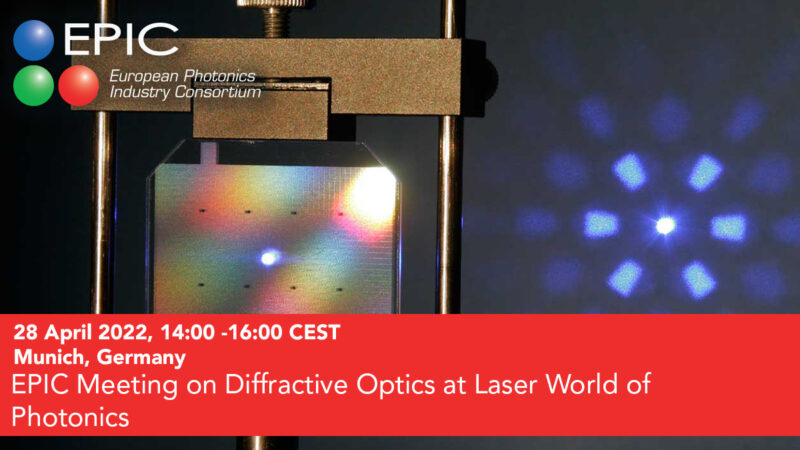
Making use of diffraction phenomena to obtain the desired pattern of light is the working principle behind beam splitters, spatial light modulators (SLMs) and many other optical elements. Diffractive optics has the advantage of enhancing the value of laser systems. The technology has many functions and is useful for many types of applications as 3D sensing, consumer electronics, AR/VR displays, automotive, robotics and IoT. Let’s discuss about current and futures challenges of this technologies as well as the emergence of new type of applications.
Agenda
Speakers

Daniela is an expert for lighting technology and optics and evaluates new technologies for automotive lighting applications in the Innovations department at HELLA. She has several years of experience in diffractive optics and did research on holography for her PhD.
Optical Engineer and Technology Scout
at HELLA

Niklas Hansson, 10+ years at NILT, currently Head of Application Engineering, dedicated to improving ToF, LiDAR and AR/VR with flat optics. Background in Engineering Physics and long career in development of manufacturing processes for DOEs and optics for AR/VR.
Head of Application Engineering
at NIL Technology

Dr. Jussi Rahomäki is Chief Product Officer of Dispelix Oy, a company focused on see-through displays for augmented reality. Dr. Rahomäki is an experienced professional in diffractive and nanoscale optics, pursuing technology and business initiatives at the forefront of augmented reality industry.
CPO
at Dispelix

Wilfried Noell (Director R&D) is responsible for R&D projects, optical designs and advanced client requests. He supports both sales and production with his dedicated team of scientists and engineers. Before joining SUSS MicroOptics, he was an R&D scientist and process engineer in the industrial x-ray business unit of the COMET AG, Switzerland. In the first decade of this millennium, he worked as a Senior Scientist and Team Leader at EPFL/UniNE IMT, where he was responsible for Optical MEMS technology and applications. During his master and PhD studies, he worked on InP-based integrated photonic circuits (PLC/PIC) and silicon photonics (SiPh) for ring resonators and optical near-field microprobes, respectively, at the TU Darmstadt and later at the IMM in Mainz, Germany.
Director R&D
at SUSS MicroOptics
Attendees
- Adam Ayeb , Engineer at Imagine Optic
- Dong-Cheon Kim , Application Engineer at Axetris
- Geoffrey Duggen , Senior Product Marketing Manager at Lumerical
- Harry Heinzelmann , Project Coordinator at CSEM / PHABULOuS
- James Pond , Principal Product Manager at Zemax
- Jessica DeGroote Nelson , Director of Technology and Strategy at Optimax
- Jessica van Heck , Managing Director at PHABULOuS Pilot Line Association
- Kamil Pierściński , Research Group Leader at Łukasiewicz
- Marc Schnieper , Senior Scientist at Süss Micro Optics
- Myun-Sik Kim , Product Manager at Axetris
- Oliver Dreissigacker , Editor in Chief at Photonics Views
- Pavel Dyachenko , Principal Optical Engineer at Huawei
- Reinhard Voelkel , CEO at SUSS MicroOptics
- Rudolf Ablinger , Business Development at Sony DADC
- Thierry Berthou , Sales Manager at SILIOS Technologies
- Thomas Pickering , Product Manager at Zemax
- Valdemar Stankevič , CTO at ELAS, UAB
- Yasar Kutuvantavida, Senior Engineer at Huawei
Contact Information
Programme Manager
Coordination
Jeremy Picot-Clemente, PhD
Technology Expert for Optics and Optical Systems
Useful resources
Related
Market Reports
Market Reports


Related
Upcoming Events
Upcoming Events
OnLine

28 October 2026.
Online Event

Related
Past Events
OnSite

13-14 October 2026.
Milan, Italy
Registration Closed
OnSite

25 June 2025.
Munich, Germany
OnLine

2 December 2024.
Online Event
Registration Closed
OnSite

29 June 2023.
Munich, Germany
Registration Closed
